Quran
Indeed We Sent Down the Reminder and We Will Guard It (15:9)
Quran 15:9 is the line people search as “We will guard it.” It is Allah’s promise to preserve the Reminder — not a slogan that we can stop reciting, checking, or living the Book.

The searches are short and sharp: “quran 15:9,” “15:9 quran,” “surah hijr verse 9,” “indeed it is we who sent down the quran,” “we will be its guardian.” People are looking for one ayah in Surah Al-Hijr. On this site it already has a dated page — 20 September 2025 — with more than thirteen thousand impressions and almost no clicks, because a calendar URL does not look like the promise they heard: We sent it down, and We will guard it.
This article is that promise, in order. It is not a dare to stop learning Arabic. It is not a claim that every translation is flawless. It is Allah’s ownership of the Reminder (al-dhikr) and His guarantee of its hifz — protection — so that a reader in any century can still meet the same Book, not a rumour of a book.
The ayah in one place
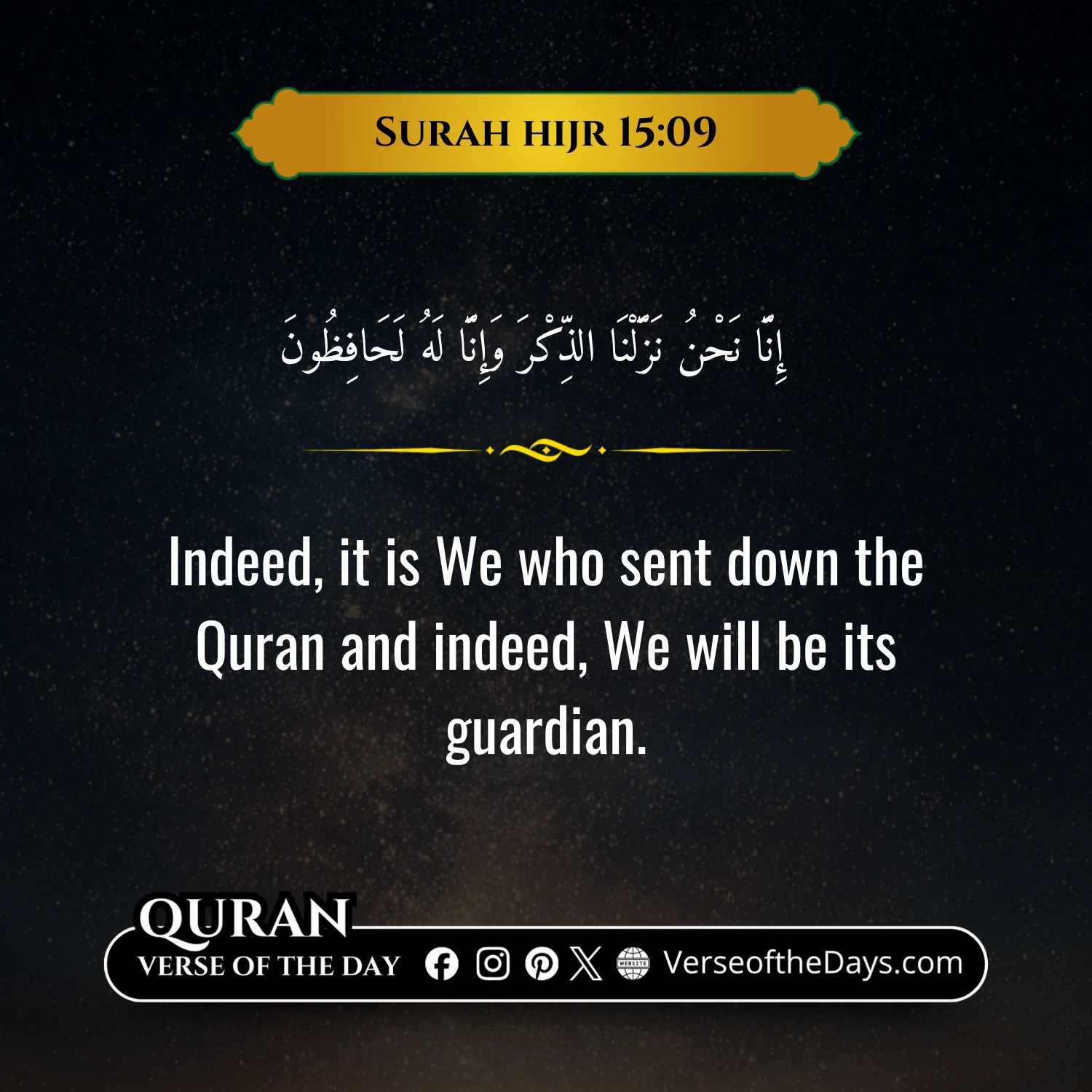
إِنَّا نَحْنُ نَزَّلْنَا الذِّكْرَ وَإِنَّا لَهُ لَحَافِظُونَ
“Indeed, it is We who sent down the Quran and indeed, We will be its guardian.”
A common English rendering is: “Indeed, it is We who sent down the Quran and indeed, We will be its guardian.” Another widespread wording keeps the Arabic term: “We sent down the Reminder, and We will surely guard it.” The Urdu on our verse page says: be-shak ham ne hi is zikr (Quran) ko nazil kiya hai aur ham hi us ke muhafiz hain. Two clauses. We sent it. We guard it. The “We” is the royal, divine We — Allah speaking of Himself — not a committee of poets taking credit.
What “the Reminder” is
Al-dhikr here is the revelation itself: the Quran as a reminder, a mention, a thing that brings back what people keep forgetting. Calling it a reminder is already a judgment on us. The problem was never that Allah failed to speak. The problem is that we sleep on what was spoken. 15:9 does not say We sent down a decoration. It says We sent down a dhikr — something meant to interrupt forgetfulness.
That is why this ayah sits well next to a daily verse habit. A guarded Book that you never open is still guarded. It is not yet your reminder. Preservation in the heavens and on the tongues of huffaz is Allah’s work. Sitting with today’s ayah is yours. If you want the smaller doorway into that habit, we already wrote what a Quran verse of the day is. This page is why you can trust the text you find there.
“We sent it down” is ownership
Inna nahnu nazzalna. The sending down is claimed. The Quran is not a cultural product that lucky Arabs invented. It is not a mood board later generations can rewrite to match the decade. The verse puts the origin above the community that received it. Communities can fail. The One who sent it does not need their success to remain Lord. That is a warning as much as a comfort. You can be a Muslim and still treat the Book as raw material for your politics. 15:9 will not bless that. It will outlive it.
Ownership also means you do not have to be anxious that the original vanished in a library fire. Previous scriptures, the Quran itself says, were entrusted to people who then altered or forgot. This ayah draws a line: this Reminder is not left in that same unguarded condition. The contrast is the point of placing 15:9 after talk of earlier nations who rejected messages.
“We will guard it” is not an excuse to be careless
Wa inna lahu la-hafizun. Guardian. Hifz. The same root as memorisation. Allah’s protection has historically run through means: people who memorised, written copies compared against recitation, a community that treated a wrong vowel as a serious matter. The promise is divine. The means are often human hands He used. That is how much of Allah’s care looks in this world: rain, and also the farmer.
- Al-dhikr: the Reminder — the Quran as that which interrupts forgetfulness.
- We sent it down: origin and ownership belong to Allah, not to a decade’s fashion.
- We will guard it: a promise of preservation, not a licence to stop checking, reciting, or living it.
- Means: huffaz, mushafs, teachers — tools under the promise, not replacements for the Promiser.
So 15:9 is not “never study isnad, never ask a teacher, never notice a misprint.” Carelessness is not tawakkul. The verse is “you can learn this Book without the dread that the original has already been replaced by a committee.” If a post tells you 15:9 means every English caption on Instagram is automatically Quran, close it. A translation is a bridge. The guarded thing is the revelation in its language.
Allah guards the Reminder. That is why you can still meet it. It is not why you are allowed to ignore it.
A working reading of 15:9
What this ayah does not say
It does not say every reciter is sinless. It does not say every tafsir is equal. It does not say your favourite preacher cannot misquote. Guarding the text is not the same as guarding every opinion hung on the text. People will still argue. People will still twist. The ayah promises that the Reminder itself remains, so that twisting can still be checked against something that did not melt.
It also does not say you must win a comment-section war. Some people search 15:9 only to throw it. Use it first as a reason to open the page, hear the recitation, and let the dhikr do what it was sent to do. If your only relationship with this ayah is debate, you have made a shield into a slogan.
How a guarded Book should change a morning
If the Quran is preserved, the next honest act is to receive it, not to collect screenshots of the promise. Read one ayah with its reference. If you cannot read Arabic well, read it slowly anyway, then a clear English or Urdu translation twice. Meaning first. The guarded Book is not honoured by a caption that cannot be found in a mushaf.
If you teach children, 15:9 is a reason to make memorisation a joy, not a threat. Hifz is participation in a means Allah has used. If you cannot memorise much, you can still be a guardian in a smaller way: you do not share fake quotes, you name the surah and ayah, you correct yourself when you misremember. That is also respect for the One who said He would guard it.
English, Urdu, and the dated pages nobody types
Search Console shows 15:9 as a query with hundreds of impressions and almost no clicks, and a dated URL — /2025/09/20 — with more than thirteen thousand impressions and a CTR near zero. The same ayah also sits on 3 June 2025. Two dates, one promise. Nobody googles the calendar. They google the verse number and the English line. This article exists so those words sit in a title, then send you into the actual ayah: Arabic, English, Urdu, tafsir.
Read it twice. Once for the two clauses: sent down; guarded. Once for your habit: do you treat the Book as a relic that protects itself while you scroll past it? If Urdu is the language of your heart, use that tab on the verse page. It is a bridge into the guarded Arabic, not a replacement for it. Then open today’s verse on the homepage. A preserved Quran still asks to be today’s reminder, not only a museum.
A small practice after you close this page
- Open 20 September 2025. Read the Arabic slowly, then English, then Urdu if that is home.
- Check one “Quran quote” you have saved. If it has no surah and ayah, do not treat it as Quran.
- Recite or listen to a short passage you already know — participation in hifz, however small.
- Do not use 15:9 only as a reply in an argument. Use it as a reason to sit with the Reminder.
If you arrived from “Quran verse of the day,” this is still one dated ayah, not a horoscope. Sit with Al-Hijr 15:9. Then return to today’s verse. A Book that is guarded is a Book you can come back to tomorrow. That is the whole kindness of the promise.
Frequently asked questions
What does Quran 15:9 mean?
Surah Al-Hijr 15:9 says Allah sent down the Reminder (the Quran) and that He will guard it. It is a promise of preservation and a claim of ownership — the Book is His sending, not a community’s invention.
Does “We will guard it” mean we do not need to memorise or check the text?
No. Allah’s protection has often run through means: memorisation, written copies, teachers. The promise is why you can trust the Reminder is still here. It is not a licence to be careless with quotes, recitation, or living the Book.
Is every English translation protected like the Arabic Quran?
No. 15:9 is about the revelation itself. A translation is a bridge into the meaning. Useful, checkable, not the guarded Arabic text. If a caption has no surah and ayah, do not treat it as Quran.
Where can I read 15:9 in Arabic, English, and Urdu on this site?
Open the dated verse page for 20 September 2025. The same ayah also appears on 3 June 2025. Each URL keeps the Arabic, translation, and tafsir after midnight.
Why do people search “indeed we sent down the reminder”?
That is a common English rendering of 15:9. They want the preservation verse, not a calendar date. The dated pages hold the ayah; this article names the line they typed.