Reflections
O Tranquil Soul: Meaning of Quran 89:27–30
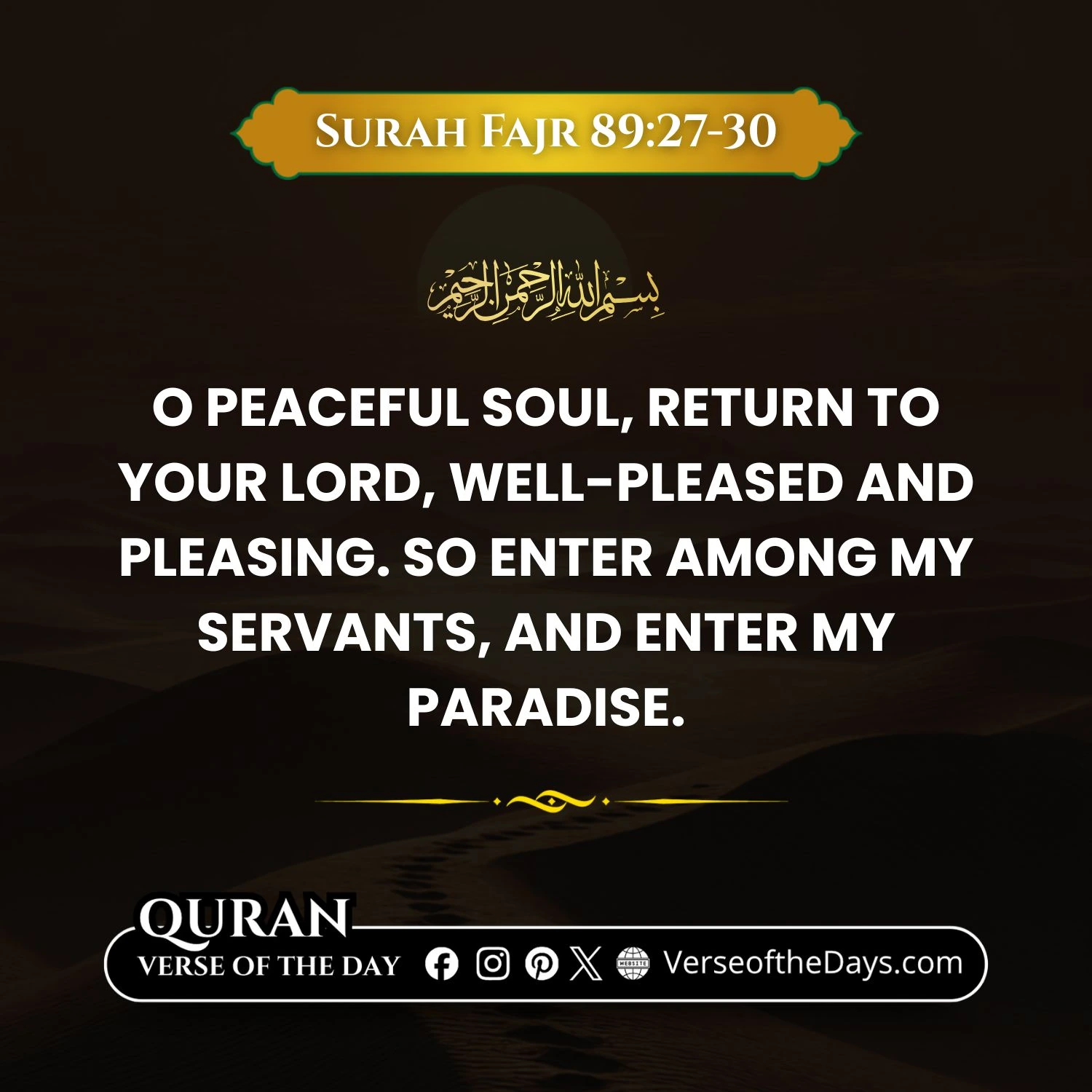
“O tranquil soul, return to your Lord” is Surah Al-Fajr 89:27–30. It is not a funeral caption only. It is the nafs mutma’inna — pleased with Allah, and pleasing to Him.

People type the English, not the date: “O tranquil soul,” “O reassured soul return to your Lord,” “Surah Fajr 27–30,” “quran 89:27-30,” “al fajr 27-30 english.” They are looking for four short ayahs at the end of Surah Al-Fajr (The Dawn). On this site they already have a page — 29 August 2025 — with more than thirteen thousand impressions and almost no clicks, because a calendar URL does not look like the sentence you heard at a janazah or saw on a card.
This article is that sentence, in order. It is not only a funeral caption. It is a welcome spoken to the nafs mutma’inna — the soul that has come to rest — invited back to its Lord, well-pleased and pleasing, into the company of His servants, into His Paradise. You do not have to be on a deathbed to need the meaning. You need it if your inner weather is still a storm and you want to know what rest in Allah actually sounds like.
The ayahs in one place
يَا أَيَّتُهَا النَّفْسُ الْمُطْمَئِنَّةُ ارْجِعِي إِلَىٰ رَبِّكِ رَاضِيَةً مَّرْضِيَّةً فَادْخُلِي فِي عِبَادِي وَادْخُلِي جَنَّتِي
“[To the righteous it will be said], "O reassured soul, Return to your Lord, well-pleased and pleasing [to Him], And enter among My [righteous] servants, And enter My Paradise."”
A common English rendering is: “O reassured soul, return to your Lord, well-pleased and pleasing [to Him], and enter among My [righteous] servants, and enter My Paradise.” Another widespread wording is “O tranquil soul.” The Arabic is ya ayyatuha al-nafs al-mutma’inna. The Urdu on our verse page says: ae itminan pane wali rooh — return, khush and pasandeeda, then enter My servants, enter My Jannah. The four moves are the whole map: the address, the return, the two ridhas, the two entries.
Nafs mutma’inna is not a mood
Mutma’inna means a soul that has settled, become still, found reassurance. It is not the same as a personality that never worries. The Quran elsewhere says mankind was created anxious — impatient in harm, withholding in ease. That is a description of the untrained self, not a medical chart. The mutma’inna is what that self can become when it has been fed on trust, worship, and a life that does not constantly argue with Allah’s qadr.
Tranquillity here is not a spa. It is the heart that can receive both a gift and a taking without collapsing into two different gods — one for the easy day, one for the hard. A contented soul is not a soul that felt nothing. It is a soul that learned where to put the feeling. If you only meet 89:27–30 on a condolence graphic, you miss the years of practice the welcome assumes.
“Return to your Lord”
Irji’i ila rabbiki. Return. The soul is not going somewhere foreign. It is going home. Death, in this address, is not an accident that happened to a believer. It is a summons with a name on it. That is why these ayahs are recited and shared when someone dies: they turn the ending into a homecoming for the one who was already His.
Return also works before the last breath. Every tawbah is a smaller return. Every prayer is a rehearsal of going back. If you only postpone “return” until a hospital corridor, you have treated the dawn surah as décor. Al-Fajr itself is named for daybreak — the hour when the world is quiet enough to remember where you are headed.
Well-pleased, and pleasing
Radiyatan mardiyya. Two directions of pleasure. The soul is pleased with its Lord — it has stopped litigating every delay. And it is pleasing to Him — its life was not only inner weather; it left a record He accepts. One without the other is incomplete. A person can claim contentment while their hands were unjust. A person can do public good while their heart stayed bitter at Allah. The ayah wants both: you are happy with Him, and He is happy with you.
- Nafs mutma’inna: a self that has settled in trust, not a self that never felt fear.
- Return: death as homecoming — and tawbah as a smaller return before that.
- Radiyatan mardiyya: pleased with Allah, and pleasing to Him. Both directions.
- Enter My servants, enter My Paradise: company first, then the garden. You are not welcomed into isolation.
That pairing is why these lines are not a cheap comfort. They do not say “everyone is fine.” They describe a particular soul. The rest of Surah Al-Fajr has already spoken about people who thought wealth was a honour and poverty a humiliation, who did not honour the orphan, who loved wealth with a devouring love. The tranquil soul is the opposite ending of that surah, not a sticker you can paste on any biography.
The welcome is tender. It is not automatic. It is spoken to the soul that learned to rest with Allah before it was asked to leave the world.
A working reading of 89:27–30
“Enter among My servants” and “enter My Paradise”
Two entries, in that order. First the company — ‘ibadi, My servants. Then Jannati, My Paradise. The possessive is intimate: My servants, My garden. You are not waved into an empty luxury. You are placed among people who belonged to Him. Loneliness is not the prize of piety. The ayah’s idea of success includes other servants, then the garden.
That also corrects a private spirituality that never needed a community. If your deen has no ‘ibad in it — no prayer with others, no mercy that costs you, no household you were gentle with — you are practising for a welcome the ayah does not describe. Paradise in this address comes after the company of servants, not instead of them.
Not a spell, not a diagnosis, not only a funeral
Do not turn 89:27–30 into a charm you play on loop to force a feeling. Recitation is worship. It is not a remote control for grief. Do not turn it into a diagnosis either. “Tranquil soul” is not a claim that a believer never needs rest, counsel, or a doctor. The Quran is guidance. It does not cancel every means Allah put in the world.
And do not lock it in the graveyard. Yes, it is a mercy to recite and remember at death. It is also a mercy to live toward that address now: fewer arguments with qadr, more honour for the orphan and the hungry (the same surah names them), less devouring love of wealth. The welcome at the end of Al-Fajr is the fruit. The rest of the surah is the soil.
English, Urdu, and the dated page nobody types
Search Console is full of Fajr 27–30 in English, Arabic numerals, and “O tranquil soul return to your Lord.” The dated URL /2025/08/29 carries the impressions. This article exists so the words sit in a title, then send you into the actual ayahs: Arabic, English, Urdu, tafsir. We published the same passage again on 19 December 2025. Two dates, one dawn. A caption that dies in a story is not a welcome you can reopen when someone you love is dying, or when you are not.
Read it twice. Once for the four moves: O soul at rest; return; pleased and pleasing; servants, then Paradise. Once for your week. If Urdu is the language of your heart, use that tab on the verse page. It is a bridge, not a different Book. If you need a neighbouring ayah while the way is still hard, 1 May 2025 carries “with hardship comes ease.” This page is the welcome at the end of the road. That page is company in the middle of it.
A small practice after you close this page
- Open 29 August 2025. Read the Arabic slowly, then English, then Urdu if that is home.
- Ask which direction is thin: are you unreconciled with Allah, or is your record unreconciled with what would please Him?
- Do one act from the rest of Al-Fajr’s warning: honour someone small, feed someone, loosen your grip on a thing you were devouring.
- Do not post the ayah as a performance over someone else’s grief unless they asked. Live one line of it where nobody is counting.
If you arrived from “Quran verse of the day” or “verse for me today,” this is still one dated passage, not a horoscope. Sit with Al-Fajr 89:27–30. Then return to today’s verse on the homepage. One welcome at dawn, one ayah for the date: both are enough if you do not reduce them to a caption.
Frequently asked questions
What does “O tranquil soul, return to your Lord” mean?
It is Quran 89:27–30, at the end of Surah Al-Fajr. Allah addresses the nafs mutma’inna — a soul that has come to rest in Him — and invites it to return, well-pleased and pleasing, among His servants, into His Paradise.
Is “O reassured soul” the same as “O tranquil soul”?
Yes. Both are English for ya ayyatuha al-nafs al-mutma’inna. Translators choose reassured, tranquil, or contented. The Arabic is one address.
Are Surah Fajr 27–30 only for funerals?
They are often recited at death because they describe a homecoming. They also describe a soul formed over a lifetime: pleased with Allah, pleasing to Him. The rest of Al-Fajr warns against devouring wealth and neglecting the orphan. The welcome is the fruit of that soil.
Where can I read 89:27–30 in Arabic, English, and Urdu?
Open the dated verse page for 29 August 2025. The same ayahs also appear on 19 December 2025. Each URL keeps the Arabic, translation, and tafsir after midnight.
Does a tranquil soul mean a believer never feels fear or grief?
No. Mutma’inna is a self that has settled in trust, not a self that never hurt. The Quran also describes the untrained human as anxious. These ayahs are a welcome, not a claim that you must never need rest, counsel, or help.