Family
And He Placed Between You Love and Mercy (Quran 30:21)
People search the English line of Surah Ar-Rum 30:21 more than the date URL. The ayah is not a wedding caption. It names tranquillity, affection, and mercy as a sign of Allah.

The line people type into Google is almost always the English, not the date: “and He placed between you love and mercy,” “and of His signs is that He created for you from yourselves mates,” “Surah Rum marriage.” They are looking for Quran 30:21 — Surah Ar-Rum (The Romans), verse 21. On this site that ayah already has a dated page, 22 October 2025. The problem is the page shows up in search and almost nobody clicks, because a calendar URL does not look like the sentence they remember.
This article is that sentence, unpacked. It is not a wedding caption, a personality test, or a promise that every house will feel easy. It is one ayah about why Allah made spouses from among yourselves, what tranquillity (sakinah) is for, and why affection (mawaddah) is not enough without mercy (rahmah).
The ayah in one place
وَمِنْ آيَاتِهِ أَنْ خَلَقَ لَكُم مِّنْ أَنفُسِكُمْ أَزْوَاجًا لِّتَسْكُنُوا إِلَيْهَا وَجَعَلَ بَيْنَكُم مَّوَدَّةً وَرَحْمَةً ۚ إِنَّ فِي ذَٰلِكَ لَآيَاتٍ لِّقَوْمٍ يَتَفَكَّرُونَ
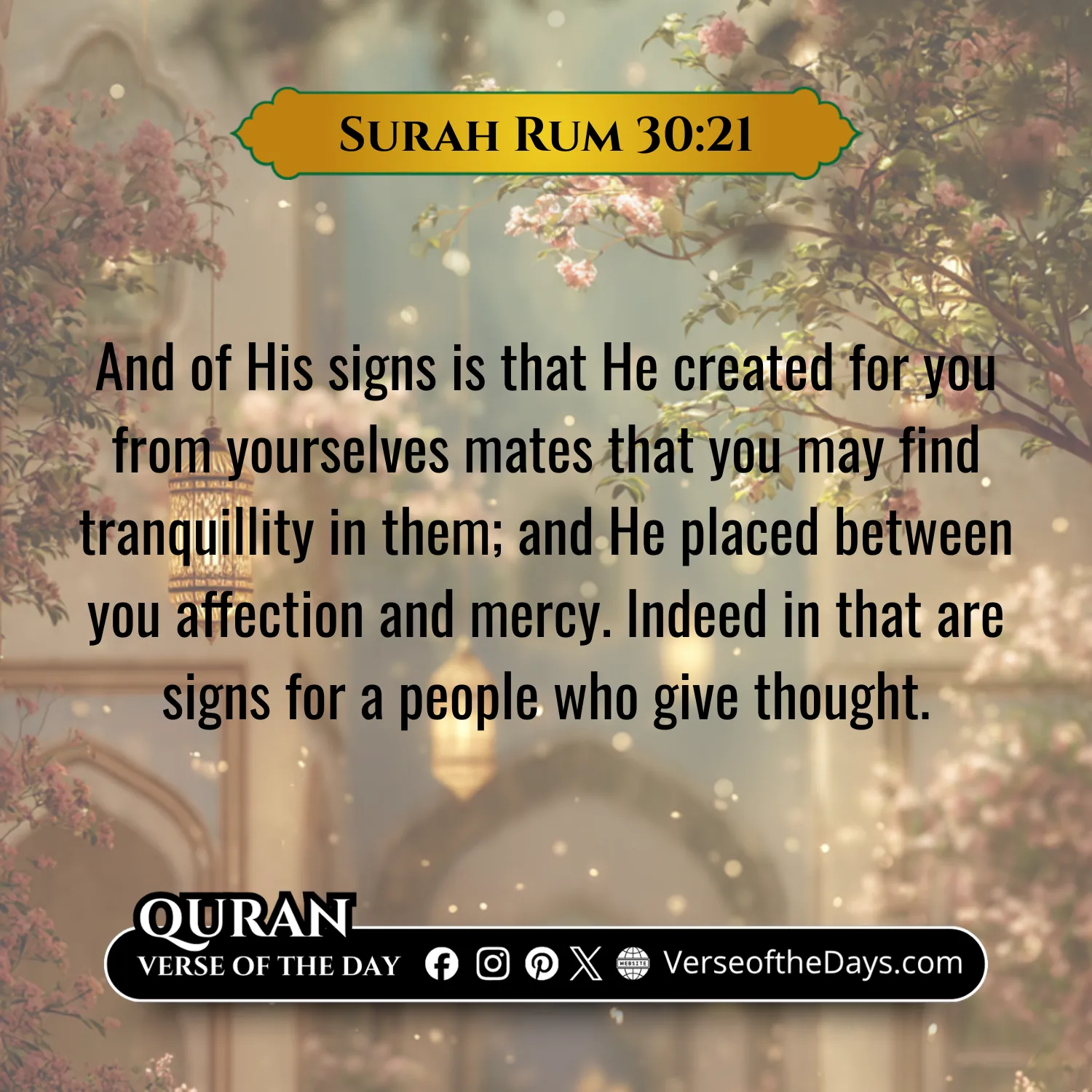
“And of His signs is that He created for you from yourselves mates that you may find tranquillity in them; and He placed between you affection and mercy. Indeed in that are signs for a people who give thought.”
A common English rendering is: “And of His signs is that He created for you from yourselves mates that you may find tranquillity in them; and He placed between you affection and mercy. Indeed in that are signs for a people who give thought.” The Urdu on our verse page carries the same three gifts: sakoon, muhabbat, and reham. If you only keep the pretty half — “love and mercy” — you miss the frame. The verse begins as a sign of Allah, not as a slogan for a photo.
“From yourselves” is the first mercy
“He created for you from yourselves mates” is easy to skip because wedding posts skip it. The Quran is pointing to shared human nature. A spouse is not a trophy from another species, not an employee, not a project to upgrade. They are from yourselves: same need for rest, same fear of being unseen, same hunger to be spoken to without humiliation. That is why unkind speech in a marriage is not a small style problem. It is a denial of the sign. The person in front of you is not raw material. They are of your kind.
That also cuts against two modern habits. One is treating marriage as a brand — a feed of matching outfits with no private gentleness. The other is treating it as a battlefield of rights with no tenderness. The ayah does not erase rights. It sets the climate in which rights can be lived: you were made for sakoon with this person, not for scoring.
Sakinah is the purpose, not the mood
The purpose clause is “that you may find tranquillity in them” — litaskunu ilayha. Sakinah here is not a spa feeling. It is the settling of the heart after restlessness. The Quran uses related language for the peace Allah sends in fear and in worship. In a home it looks like this: you can enter the room without bracing. You can tell the truth without a performance. You can sleep. Many people search 30:21 when the opposite is true — the house is loud, or silent in a bitter way, or full of jokes that leave a bruise.
If your house is not tranquil today, the ayah is not mocking you. It is naming the design. A design can be neglected. Tranquillity is something Allah placed as the point of the bond; it still has to be protected with speech, money, time, and the refusal to humiliate. A verse on kind speech beating hurtful charity belongs next to this one. Gifts that shame a spouse are not mawaddah. They are dust on a stone.
Mawaddah and rahmah are not synonyms
Allah did not say He placed only love between you. He named two things. Mawaddah is affection — the warmth that draws two people toward each other, the liking, the want to be near. Rahmah is mercy — the tenderness that stays when liking is tired, when illness comes, when a sentence came out wrong, when the other person is no longer impressive. Love without mercy becomes appetite. Mercy without any affection can become cold duty. The ayah holds both.
- Mawaddah: the pull toward the other person — fondness, warmth, wanting their face in the room.
- Rahmah: the covering of faults — patience with weakness, care in sickness, a soft answer after a hard day.
- Sakinah: the result the verse aims at — a heart that can rest with this person, not perform for them.
That is why 30:21 is searched by people who are engaged, newly married, and also by people who are exhausted. The exhausted ones are not wrong to come here. Mercy is the part of the ayah that still applies when the wedding playlist is over. If you can only do one thing after reading this, do the merciful thing: delay the reply that would score a point. The affection can be rebuilt more easily than a tongue that has been used as a weapon.
Love draws you into the room. Mercy is why the other person is still safe once the door is closed.
A working reading of mawaddah and rahmah in 30:21
“Signs for a people who give thought”
The verse does not end at the couple. It ends at people who think. Marriage is listed among Allah’s signs in Surah Ar-Rum, in a passage that also points to the heavens, the earth, and the variation of tongues and colours. A quiet house is not a small private hobby. It is supposed to make you notice the One who designed rest in another human being. If a marriage only makes you notice yourself — your rights, your aesthetic, your parents’ opinions — you have used the sign as decoration.
Giving thought also means you do not turn 30:21 into a superstition. Reciting it is not a spell that forces a difficult spouse to become gentle. The ayah describes what Allah placed. You still choose speech. You still choose whether to overlook. You still ask Allah for the sakoon you cannot manufacture. Thoughtful people hold the verse and the effort together.
How to read 30:21 when the marriage is heavy
Some readers arrive from a fight. Some arrive from loneliness inside a legal marriage. The Quran is allowed to describe an ideal without pretending every home has reached it. Do not use this ayah as a stick: “If you were a real believer we would already have sakinah.” That sentence is the opposite of rahmah. Use it as a map. Ask where affection thinned. Ask where mercy was replaced by sarcasm. Ask what one covering act would look like tonight — a meal, a postponed argument, a dua made without announcing it.
This is also not a command to stay in harm. Mercy does not mean absorbing cruelty as piety. The same Book that praises overlooking also forbids oppression. If a home is unsafe, 30:21 is not a lock on the door. It is still true as a picture of what Allah intended; it is not a fatwa for your case. For that you need people you trust, not a search result.
English, Urdu, and the dated page people never click
Search Console is blunt about this verse. The English phrasing gets thousands of impressions. The dated URL /2025/10/22 gets tens of thousands more and almost no clicks, because nobody types a calendar. They type the line they heard in a khutbah or saw on a card. That is why this article exists: so the words you searched sit in a title, then send you into the actual ayah — Arabic, English, Urdu, tafsir — on a URL that will still be here tomorrow.
Read it twice. Once for the vocabulary: signs, from yourselves, tranquillity, affection, mercy, people who think. Once for the house you actually live in. If Urdu is the language of your heart, use that tab on the verse page; it is a bridge, not a different Quran. If you want a second family ayah beside it, 18 October 2025 carries the dua in Surah Al-Furqan for spouses and children who are a comfort to the eyes. 30:21 is the sign in the bond. That dua is the ask that the bond stay righteous.
We also published the same ayah on 14 July 2025. Two dates, one verse. The archive is the point. A marriage ayah that only lives in a screenshot is not a sign you can return to when the week gets sharp.
A small practice after you close this page
- Open the dated verse. Read the Arabic slowly, then the English, then the Urdu if that is home.
- Name one act of mawaddah you have been withholding — a kind word, time, a face that is not in a phone.
- Name one act of rahmah — a fault you will not replay tonight.
- Do not post the ayah as a performance. Live one line of it where nobody is counting likes.
If you came here from “Quran verse of the day” or “verse for me today,” this is still one dated ayah, not a horoscope. It happens to be the line Google already associates with this site. Sit with it. Then go back to today’s verse on the homepage. One sign in a marriage, one ayah for the date: both are enough for a night if you do not rush past the words.
Frequently asked questions
What does “and He placed between you love and mercy” mean in Quran 30:21?
It is part of Surah Ar-Rum 30:21. Allah describes spouses as a sign: created from yourselves so you may find tranquillity, with affection (mawaddah) and mercy (rahmah) placed between you. Love draws; mercy covers faults when love is tired.
Which surah says Allah created mates from yourselves?
Surah Ar-Rum (The Romans), verse 21. A common English start is “And of His signs is that He created for you from yourselves mates that you may find tranquillity in them.”
Is Quran 30:21 only for newlyweds?
No. Mawaddah is the warmth that begins a bond; rahmah is the mercy that keeps a home safe when days are ordinary or hard. The verse is a sign for people who think, not a caption for one wedding week.
Where can I read 30:21 with Arabic, English, and Urdu on this site?
Open the dated verse page for 22 October 2025. The same ayah also appears on 14 July 2025. Each URL keeps the Arabic, translation, and tafsir after midnight.
Does 30:21 mean I must stay in a harmful marriage?
No. The ayah describes the design of companionship — tranquillity, affection, and mercy. It does not license oppression. Safety and trusted counsel matter; a search result is not a ruling for your case.